
Should people over 50 lift heavy weights, or is it safer to stick with lighter weights and higher repetitions? It’s a question that many people ask as they get older, especially when they start hearing that heavy lifting can damage their joints, increase their risk of injury, or put too much strain on their bodies.
But here’s the problem with that advice: Avoiding heavy weights simply because you’re over 50 could be holding you back from building muscle, getting stronger, and maintaining your physical independence as you age.
The truth is that your muscles don’t suddenly stop responding to challenging workouts when you turn 50. With the right approach, you can continue building muscle, improving strength, supporting bone health, and maintaining the physical capabilities you need to enjoy an active life.
So, should people over 50 lift heavy weights? Yes, many can and should incorporate challenging resistance training into their workouts.
However, lifting heavy doesn’t mean attempting maximum lifts, ignoring pain, or pushing through every set until you can’t move another inch. It means choosing a weight that challenges your current abilities while allowing you to maintain good technique and recover adequately between workouts.
In this article, we’ll explore the benefits and potential risks of lifting heavy weights after 50, how heavy you should actually lift, which exercises are worth including in your routine, and how to balance training intensity with recovery. You’ll also learn how to approach heavy strength training safely, whether you’re an experienced lifter or just getting started.
Because getting older doesn’t mean you have to settle for getting weaker. With a smart, progressive training plan, you can continue building strength and muscle well into your 50s, 60s, 70s, and beyond.
Should People Over 50 Lift Heavy Weights?
Yes, people over 50 can benefit significantly from lifting heavy weights. In fact, if your goal is to build muscle, increase strength, and maintain an active lifestyle as you age, challenging resistance training should be an important part of your fitness routine.
The key is understanding what lifting heavy actually means and how to approach it intelligently.
One of the biggest misconceptions about strength training after 50 is that you should automatically reduce the weight you lift as you get older.
While your body may require more attention to recovery, and certain exercises may need to be modified to accommodate injuries or physical limitations, there’s no universal rule that says you must switch to light weights simply because you’ve reached a certain age.
Your muscles still respond to resistance training. By gradually challenging them with appropriate loads, you can stimulate muscle growth, improve strength, and counteract the age-related loss of muscle mass that can make everyday activities more difficult.
Yes, Heavy Strength Training Can Be Beneficial After 50
As you get older, maintaining muscle mass and strength becomes increasingly important. Without regular resistance training, you may gradually lose muscle and experience declines in physical performance.
These changes can make everything from carrying groceries to climbing stairs and participating in recreational activities more challenging.
Heavy strength training can help counteract these changes by providing the stimulus your muscles need to adapt and grow stronger.
For example, exercises such as squats, leg presses, chest presses, rows, and pulldowns can help you develop strength across your major muscle groups. Over time, that strength can translate into better physical performance, greater confidence, and an improved ability to remain independent.
Challenging resistance training can also support bone health and help preserve the physical capacity you need to enjoy an active retirement.
However, the benefits don’t depend on lifting the heaviest weight possible. They come from applying an appropriate training stimulus consistently and progressively.
If you’re an experienced lifter, that might mean continuing to use relatively heavy weights while managing your training volume and recovery.
If you’re new to strength training, it might mean starting with lighter loads, learning proper technique, and gradually working toward more challenging weights.
The important principle is to train according to your abilities, not to limit yourself based on your age alone.
What Does “Lifting Heavy” Actually Mean After 50?
When people hear the phrase “lifting heavy weights,” they often picture someone struggling to complete a maximum-effort barbell squat or bench press. But that’s not necessarily what heavy strength training needs to look like.
In reality, heavy is relative to your current strength and the exercise you’re performing.
A 20-pound dumbbell might be challenging for one person but relatively light for another. The appropriate training weight depends on your experience, strength, exercise selection, and physical condition.
A useful way to determine whether you’re lifting an appropriate weight is to pay attention to how difficult the final repetitions feel.
For example, suppose you’re performing 10 repetitions of a chest press. If you finish the set feeling as though you could easily complete another 10 repetitions, the weight is way too light to stimulate an increase in muscular strength.
On the other hand, if you’re struggling to complete the sixth repetition, your technique is deteriorating, and you have to twist or jerk your body to move the weight, the load is too heavy.
A more productive approach is to choose a weight that requires a maximum effort to complete the final repetitions, while allowing you to maintain control throughout the set.
The goal is to challenge your muscles sufficiently without allowing fatigue to compromise your technique or create unnecessary recovery demands.
Should People Over 50 Lift Heavy weights, or Stick to Light Weights?
The answer depends on what you’re trying to achieve, but you don’t necessarily have to choose one or the other.
Both heavy and light weights can stimulate muscle growth when the training is sufficiently challenging. However, the loads you use can influence the type of adaptations you develop.
Heavier weights are particularly useful for improving maximal strength because they train your muscles and nervous system to produce greater force against substantial resistance.
Moderate weights are also highly effective for building muscle and often provide a practical balance between resistance, repetitions, and fatigue.
Lighter weights can be useful, too, particularly when you’re learning an exercise, managing certain joint limitations, or performing movements that are difficult to load heavily. However, light weights may require more repetitions and slower repetition speed to produce a comparable muscle-building stimulus.
For most people over 50, a combination of loading ranges makes sense.
You might perform leg presses for 9–12 repetitions, chest presses for 7-10 repetitions, and abdominal crunches for 12–15 repetitions. The exact repetition ranges matter less than selecting appropriate weights, using sound technique, and making your sets sufficiently challenging.
It’s also important to recognize that lifting heavy doesn’t automatically mean lifting recklessly. You can train hard without regularly attempting maximum lifts, grinding through multiple forced reps, or using weights that exceed your ability to control them.
The bottom line: If you’re wondering “should people over 50 lift heavy weights?”, the answer is yes, provided the training is appropriate for their abilities and circumstances.
You don’t need to abandon challenging resistance as you age. Instead, focus on progressive overload, good technique, adequate recovery, and a training program that helps you become stronger over time.
The Benefits of Lifting Heavy Weights After 50
If you’re still wondering, “Should people over 50 lift heavy weights?”, it helps to understand what challenging resistance training can do for your body as you age.
While walking, cycling, and other forms of physical activity are valuable for overall health, strength training provides something these activities don’t: a direct stimulus for building and maintaining muscle strength. And as you get older, preserving your strength becomes increasingly important for maintaining physical independence, staying active, and enjoying the activities you love.
The benefits go well beyond simply looking more muscular. Appropriately challenging weight training can help you preserve muscle mass, improve physical function, support bone health, and maintain a higher level of fitness well into your later years.
Let’s look at the most important benefits of lifting heavy weights after 50.
Build and Maintain Muscle Mass as You Age
One of the biggest challenges of aging is maintaining your movement-producing muscle mass.
Beginning in adulthood, muscle mass and strength can gradually decline, particularly when physical activity levels decrease. This process can accelerate with advancing age and inactivity, eventually contributing to a condition known as sarcopenia, which involves the loss of muscle strength and muscle mass.
The good news is that this decline isn’t inevitable, and you don’t have to accept becoming weaker simply because you’re getting older.
Resistance training stimulates the processes involved in muscle repair and growth. When you challenge your muscles with sufficient resistance, your body receives a signal to adapt to that demand.
With consistent training, adequate protein, and sufficient recovery, you can maintain existing muscle, and potentially build additional muscle, even in your 50s, 60s, and beyond.
This is one reason lifting heavy weights after 50 can be so valuable. Challenging your muscles helps provide the stimulus needed to maintain and develop strength, rather than allowing your training to become so easy that it no longer produces meaningful progress.
Incorporating heavier resistance can be particularly useful for developing the strength that supports everyday activities. For example, stronger leg muscles can make it easier to climb stairs, get up from a low chair, and walk uphill.
Stronger back, chest, and arm muscles can help with carrying luggage, moving furniture, and performing other physically demanding tasks.
If your goal is to build or maintain muscle after 50, your workouts need to provide a meaningful challenge. Simply going through the motions with weights that are consistently too easy may not deliver the results you’re looking for.
Increase Strength and Make Everyday Activities Easier
Muscle size and muscle strength are related, but they’re not the same thing.
You can improve strength by increasing the amount of force your muscles can produce, even before you notice substantial changes in muscle size. This improvement reflects adaptations in your nervous system as well as changes in the muscles themselves.
Why does this matter after 50?
Because everyday life places demands on your strength, and those demands don’t disappear when you retire.
Carrying groceries, lifting a suitcase into an overhead compartment, getting up from the floor, and participating in recreational sports all require some combination of muscular strength, coordination, and physical endurance.
As your strength increases, these activities can become easier. You may also find that you have more physical capacity in reserve, meaning everyday tasks require a smaller proportion of your maximum effort.
Consider two people who can both lift a 30-pound suitcase. For the person whose maximum lifting capacity is 35 pounds, that task is relatively demanding. For someone who can comfortably lift 70 pounds, the same suitcase represents a much smaller challenge.
Developing greater strength gives you a larger reserve of physical capacity.
Heavy resistance training can be especially helpful for this purpose because training with heavier loads is generally more effective for improving maximal strength than training exclusively with light loads.
Of course, the objective isn’t to prove how much weight you can lift. It’s to build the strength that allows you to remain capable, confident, and physically independent as you age.
Support Bone Density and Skeletal Health
Muscle isn’t the only tissue that benefits from resistance training. Your bones also respond to mechanical loading.
Bones adapt to the forces placed on them, and appropriately prescribed resistance exercise can help maintain or improve bone mineral density in some individuals. This becomes increasingly important with age because bone loss can contribute to osteoporosis and a higher risk of fractures.
Weight-bearing resistance exercises such as squats, leg presses, overhead presses, and certain hip-hinge movements can place useful loads on the muscles and bones involved in those movements.
Over time, an appropriately designed program may help support skeletal health while improving the strength and coordination needed for daily activities.
However, the relationship between exercise and bone health requires some nuance. Not every exercise produces the same bone-loading stimulus, and improvements in muscle strength don’t automatically translate into equivalent increases in bone density.
If you have osteoporosis, a history of vertebral fractures, or another condition that affects bone strength, you may need to modify certain exercises and loading strategies. A qualified healthcare professional can help determine which movements and resistance levels are appropriate for your circumstances.
The important takeaway is that getting older doesn’t mean you should avoid resistance exercise to protect your bones. For many people, properly prescribed strength training is an important part of maintaining musculoskeletal health.
Improve Balance, Mobility, and Physical Function
Balance and mobility often receive less attention than muscle size and strength, but both are essential for staying active as you get older.
Strong legs and hips help you control your body during walking, climbing stairs, changing direction, and standing up from a seated position. Strengthening these muscles can improve your ability to perform everyday movements and respond to the physical demands of an active lifestyle.
Resistance training can also contribute to better physical function by improving coordination and movement confidence.
For example, if you regularly train your legs with appropriately challenging squats or leg presses, getting up from a chair may become easier as your strength improves. Stronger hip and leg muscles can also help you negotiate inclines, uneven surfaces, and other everyday obstacles.
This is particularly important if you’ve experienced falls, have difficulty walking, or feel unsteady on your feet.
For otherwise healthy adults over 50, the combination of strength training and other forms of physical activity can help maintain the physical capabilities needed to remain active and independent.
Improve Metabolic Health and Body Composition
Another potential benefit of lifting heavy weights after 50 is improved body composition.
As people age, they may gradually lose muscle while gaining body fat, particularly if their activity levels decline. This change can affect physical performance and metabolic health.
Resistance training helps address one part of this problem by preserving or increasing lean muscle mass.
If your goal is to lose body fat, strength training can help you retain muscle while following an appropriate calorie-controlled nutrition plan. This matters because losing weight without resistance training can result in the loss of some muscle along with body fat.
Maintaining muscle can also support glucose regulation, as skeletal muscle plays an important role in how your body uses glucose.
Regular resistance training can improve aspects of metabolic health, including insulin sensitivity, although the extent of the benefits varies among individuals.
It’s important not to overstate the effect of heavy lifting on fat loss. Lifting weights alone doesn’t guarantee a leaner body, and adding muscle produces only a small increase in calorie expenditure at rest.
For the best results, combine a consistent strength-training program with adequate protein, an appropriate overall calorie intake, and regular aerobic activity.
The goal is to develop a stronger body while maintaining a healthy level of body fat—not simply to move the number on the scale.
Maintain Confidence, Resilience, and an Active Lifestyle
The benefits of strength training after 50 aren’t limited to measurable changes in muscle size, strength, or body composition.
There is also something valuable about knowing that your body can still adapt, improve, and accomplish things that once seemed difficult.
When you follow a structured weight-training program, you can (and should) track your progress in concrete ways. You might lift a heavier weight, complete more repetitions, or find that an exercise that once intimidated you now feels manageable.
These improvements provide tangible evidence that your effort is paying off.
They can also build confidence in your physical abilities, which may encourage you to remain active and pursue new challenges.
Perhaps you want to keep hiking, travel without worrying about carrying your luggage, participate in recreational sports, or simply maintain the ability to do things for yourself. Developing strength can help support those goals.
For people who have lifted weights for decades, continuing to train can also preserve an important part of their identity and lifestyle. For beginners, it can be an opportunity to discover that meaningful improvements are still possible later in life.
Of course, exercise isn’t a substitute for medical care, and strength training doesn’t eliminate every consequence of aging. But it gives you a practical way to invest in your physical capabilities.
Ultimately, one of the biggest benefits of lifting heavy weights after 50 is that you’re training for the life you want to live—not just for the next workout.
How to Start Lifting Heavy Weights Safely After 50
Now that you understand why lifting heavy weights after 50 can be beneficial, the next question is how to get started without taking unnecessary risks.
The good news is that you don’t need an advanced training program, expensive equipment, or years of experience to begin building strength. What you need is a sensible approach that allows your body to adapt gradually while you develop the skills necessary to train effectively.
Whether you’re an experienced lifter returning after a break, or someone who has never followed a structured strength-training program, the principles are largely the same: assess your current abilities, learn proper technique, progress gradually, and give your body enough time to recover.
Here are five steps to help you start lifting heavy weights safely after 50.
Step 1: Assess Your Current Fitness and Training Experience
Before deciding how much weight to lift, take an honest look at your current fitness level.
If you’ve been strength training consistently for years, you should be able to continue lifting heavy weights with a few adjustments to your training volume, exercise selection, or recovery schedule.
However, if you’ve spent several years away from the gym, you shouldn’t assume the weights you used to lift are still appropriate. Your muscles may regain strength relatively quickly with consistent training, but your strength, exercise tolerance, technique, and ability to recover will need time to catch up.
The same principle applies if you’re completely new to resistance training. You don’t need to begin with heavy weights to make progress. Start with loads that allow you to learn the movements comfortably, then gradually increase the challenge as your strength improves.
Consider the following questions before getting started:
- Can you perform basic movements such as sitting down and standing up from a chair without significant difficulty?
- Do you have any existing joint problems, previous injuries, or limitations that affect your movement?
- Have you experienced unexplained chest discomfort, dizziness, fainting, or unusual shortness of breath during physical activity?
- Have you been diagnosed with a medical condition that could affect your ability to perform strenuous exercise?
Your answers can help you determine whether you can begin with a straightforward strength-training routine or would benefit from professional guidance first.
If you have a known cardiovascular condition, uncontrolled high blood pressure, significant osteoporosis, a recent injury, or another condition that could affect exercise safety, consult an appropriate healthcare professional about your training plans.
For otherwise healthy adults, age alone isn’t a reason to avoid challenging resistance training. The important thing is to match the training demands to your current abilities and health.
Step 2: Master Your Technique Before Increasing the Weight
One of the most important rules for lifting heavy weights after 50 is to establish good technique before worrying about how much weight you’re lifting.
Using a heavier load doesn’t automatically make an exercise more effective. If the weight forces you to shorten the movement excessively, use momentum, or lose control, you’ll be sacrificing the quality of your training and increasing your risk of injury.
Start with weights you can lift in about 2 seconds and lower in about 4 seconds under full muscular control with no momentum for at least 10 reps.
Once you can perform the exercise in this way consistently, you can gradually add resistance.
You may also find it helpful to use machines when learning new movements. Machines can provide additional stability and make it easier to concentrate on producing force without having to manage as many balance and coordination demands.
However, free weights and machines can both be effective. Choose the option that allows you to train the target muscles comfortably and consistently.
If you’re unsure about your technique, consider working with a qualified personal trainer who has experience working with adults over 50.
Step 3: Increase the Weight Gradually Using Progressive Overload
Once you’ve established a solid foundation, you can begin increasing the resistance.
This is where the principle of progressive overload becomes important.
Progressive overload means gradually increasing the demands placed on your muscles as your body adapts to training. You might accomplish this by lifting more weight, performing additional repetitions, or improving your control over an exercise.
For most people interested in building muscle and strength after 50, increasing resistance over time is an important part of the process.
However, you don’t need to increase the weight at every workout.
Suppose you’re performing a leg press. You begin with a weight that challenges you but allows you to maintain good technique for 9-12 repetitions.
Over several workouts, you’ll be able to perform 12 or more repetitions while maintaining control before you’re reach the point of maximum fatigue and have to stop.
At that point, you’ll be ready to increase the weight slightly and work your way back toward the lower end of the repetition range.
This approach is called double progression: you increase repetitions within a target range before increasing the resistance.
A few principles will help you apply progressive overload effectively:
- Make small increases. You don’t need to make dramatic jumps in weight to stimulate progress.
- Prioritize technique. Increase resistance only when you can handle the current load with consistent control.
- Allow for individual differences. Some exercises and muscle groups may progress faster than others.
Remember that the purpose of progressive overload is to create a manageable training challenge that your body can adapt to—not to see how much weight you can add in the shortest possible time.
Step 4: Warm Up Before Your Heavy Working Sets
Before lifting challenging weights, spend a few minutes preparing for the exercises you’re about to perform.
A warm-up doesn’t need to be complicated. You might begin with several minutes of easy walking, cycling, or another comfortable activity, followed by lighter sets of your planned exercises.
For example, if your working sets involve a challenging chest press, start with a lighter weight for a comfortable set of 5-6 repetitions. If necessary, perform another warm-up set with a slightly heavier load before beginning your working sets.
The purpose is to prepare for the specific demands of the exercise without creating unnecessary fatigue.
Keep these points in mind:
- Begin with a load that’s easy to control.
- Increase the resistance progressively as needed.
- Avoid turning your warm-up into a demanding workout.
- Pay attention to any unusual pain, stiffness, dizziness, or other concerning symptoms.
A proper warm-up can help you transition into challenging work more comfortably, but it doesn’t eliminate the risks associated with poor technique, excessive loading, or inadequate recovery.
Step 5: Use Appropriate Equipment and Safety Measures
Your training environment matters, particularly when you begin working with heavier loads.
Fortunately, you have several options for building muscle and strength without putting yourself in unnecessarily risky situations.
Weight machines can be an excellent starting point because they provide a relatively stable movement path and are often easy to adjust. Exercises such as leg presses, chest presses, seated rows, and lat pulldowns can train major muscle groups effectively.
Dumbbells allow you to move more freely and can be useful for exercises such as chest presses, rows, and squats. However, lifting dumbbells into position and returning them safely requires some coordination and control.
Resistance bands provide a source of straight-line resistance, similar to free weights, but bands have the advantage of providing resistance in a horizontal plane as well.
Make sure that your equipment is properly adjusted so that you don’t experience any and joint pain, and won’t get trapped under anythng. You should also understand how to enter and exit each exercise safely.
The best equipment is the equipment that allows you to train your muscles effectively, progress consistently, and manage the demands of each exercise.
One final point: Lifting heavy weights after 50 should challenge your muscles, not require you to gamble with your safety. You can train hard, make substantial progress, and build impressive strength without attempting maximal lifts or using weights you cannot control.
Start at an appropriate level, develop your technique, and gradually increase the demands as you become stronger. With that approach, heavy strength training can become a sustainable part of your fitness routine for years to come.
The Best Exercises for Heavy Strength Training After 50
Once you’ve decided that lifting heavy weights after 50 belongs in your fitness routine, the next step is choosing the right exercises.
The good news is that you don’t need an elaborate workout filled with dozens of movements to build muscle and strength.
A relatively small selection of well-chosen exercises can train your major muscle groups, provide a strong stimulus for muscle growth, and help you maintain the physical capabilities you need as you get older.
The key is to focus on exercises that allow you to progressively increase resistance while maintaining good technique and a comfortable range of motion.
For most people over 50, this means prioritizing movements that train the legs, hips, chest, back, shoulders, and arms. You can perform these exercises using free weights, weight machines, cables, or a combination of equipment.
Here are some of the best exercises to consider when designing a heavy strength-training program after 50.
Leg Press and Squat Variations
Your legs contain some of the largest muscles in your body, making lower-body training an important part of any program designed to build strength after 50.
Exercises such as leg presses and squats target the quadriceps and glutes while also involving other muscles that help stabilize and control movement.
Developing lower-body strength can make everyday activities such as climbing stairs, getting out of a chair, walking uphill, and carrying heavy objects easier.
The leg press is an excellent option for people who want to train their legs with substantial resistance while maintaining safety.
Because the machine supports your body and will catch the weight in a safe resting position, you can focus on producing force through your legs without needing to balance a free weight.
However, the machine still requires proper setup. Adjust the seat, use a comfortable range of motion, and avoid lowering the weight so far that your lower back rounds away from the backrest.
Squats offer another effective way to develop lower-body strength. Depending on your experience and mobility, you might use bodyweight squats, dumbbell squats, resistance band squats, or machine squats.
If you’re new to strength training, dumbbell squats can be a practical starting point. More experienced lifters may be able to continue progressing with heavier squat variations.
You don’t have to perform deep barbell squats to benefit from lower-body training. Choose a variation that suits your abilities and allows you to maintain control and safety.
When performing heavy leg exercises, increase the resistance gradually and avoid forcing repetitions when your technique begins to deteriorate.

Chest Press and Bench Press Variations
Pressing exercises help develop the chest, triceps, and front portions of the shoulders.
These muscles contribute to everyday activities such as pushing open heavy doors, moving objects, and getting yourself into or out of certain positions.
They are also important for building upper-body muscle and maintaining balanced strength.
A machine chest press is a practical choice for many adults over 50 because it provides stability and allows you to adjust the resistance in manageable increments.
Dumbbell chest presses offer greater freedom of movement and allow each arm to work independently. Barbell bench presses can also be effective for experienced lifters who are comfortable with the movement and have appropriate safety equipment.
The best option depends on your training experience, shoulder comfort, and ability to position the weight safely.
When performing pressing exercises, use a controlled range of motion, keep your wrists stable, and avoid bouncing the weight or forcing your shoulders into an uncomfortable position.
You can build substantial chest and triceps strength without testing your maximum bench press.
For muscle growth, sets in a moderate repetition range (such as 7-10) can be particularly practical. As you become stronger, gradually increase the resistance while maintaining good technique.

Rows
If your training routine includes pressing exercises, it’s important to balance them with pulling movements.
Rows target the muscles of your upper and middle back, including the latissimus dorsi, rhomboids, and trapezius, while also involving the biceps and other elbow-flexor muscles.
Strong back muscles contribute to pulling strength and help you control your upper body during many daily activities.
Chest-supported rows are particularly useful for people who want to train their back without placing as much stress on their lumbar spine. By supporting your torso against a bench or machine pad, you can concentrate on the pulling movement without low back pain.
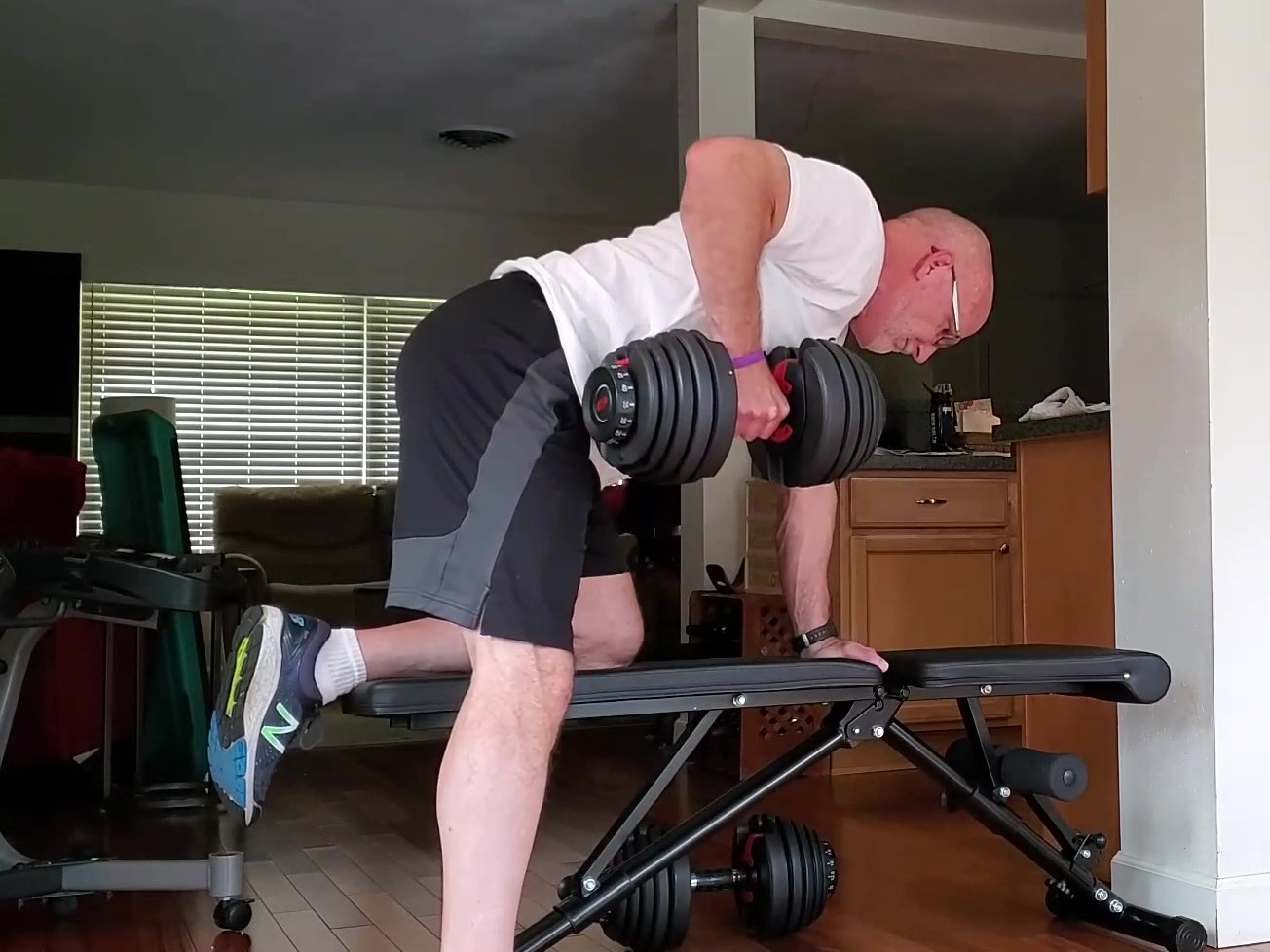
Seated cable rows and machine rows are also effective options. Free weight options include 1-arm dumbbell rows, with your free arm providing support to maintain appropriate positioning and control.
To perform a row effectively, pull the handle or weight toward your torso without using excessive momentum. Keep your shoulders and torso controlled rather than jerking the weight backward to complete a repetition.
As your strength improves, increase the resistance gradually.
You should feel your back muscles doing the work rather than relying on swinging your body to move a load that’s too heavy.
Lat Pulldowns and Other Vertical Pulling Exercises
Lat pulldowns are another excellent exercise for developing upper-body strength after 50.
They primarily target the latissimus dorsi, the large muscles running along the sides of your back, while also involving your biceps and other upper-body muscles.
These muscles contribute to pulling movements and help you develop a stronger, more muscular upper body.
The lat pulldown machine also makes it relatively easy to adjust resistance and track your progress over time.
To perform the exercise, secure your thighs under the pads, use a palms-up, underhand grip, and pull the bar toward your collarbones while keeping your torso upright. Return the weight slowly rather than allowing the stack to drop.
Avoid excessive swinging or pulling the bar behind your neck. Neither is necessary to build strong back muscles.
If you have shoulder limitations, experiment with a closer grip and and limit the stretching end of the range of motion, or choose another pulling exercise that better suits your needs.
For many people over 50, lat pulldowns provide an effective way to train the back with challenging resistance without the technical demands of more complex free-weight exercises.

Shoulder Presses and Arm Exercises
Although compound exercises such as chest presses and rows train your arms and shoulders, direct shoulder and arm exercises can help you develop these muscles further.
Shoulder presses target the deltoids and triceps, while lateral raises emphasize the side portions of the shoulders. Biceps curls and triceps extensions provide additional work for the muscles that bend and straighten your elbows.
These exercises can help improve upper-body strength and muscle development without requiring the same systemic demands as heavy leg or back exercises.
For shoulder pressing, you might use dumbbells, a machine, or another variation that allows you to move comfortably. A seated machine press may be a good choice if you prefer additional stability.
However, overhead pressing isn’t appropriate for every shoulder. If you experience pain or have limited overhead mobility, use a comfortable alternative such as an incline chest press rather than forcing the movement.
Lateral raises, bicep curls, and triceps extensions are often best performed with controlled repetitions and moderate loads to avoid dangerous form breaks. Focus on controlling the movement instead of swinging the weights or using momentum to complete repetitions.
For many adults over 50, direct arm and shoulder exercises are useful additions to a program built around larger compound movements.

Should You Use Free Weights or Weight Machines After 50?
One common question is whether people over 50 should favor free weights or weight machines when lifting heavy.
The answer is that both can be effective for building muscle and strength. Neither is automatically superior for every individual.
Free weights, including dumbbells and barbells, allow you to move through relatively unrestricted movement paths. They are very versatile, low maintenance, and offer a wide variety of exercise options.
However, some free-weight movements require more technical skill, and certain exercises can be difficult to set up or perform safely when the load becomes challenging.
Weight machines guide the movement along a designed path and often provide additional stability. They can make it easier to strength train safely by yourself, adjust resistance, and train hard without having to manage as many balance demands.
Machines can be especially useful for beginners, people returning after a long layoff, and experienced lifters who want to bea able to train to muscular failure safely.
For example, you could use a leg press instead of a barbell squat, a machine chest press instead of a barbell bench press, and a chest-supported row instead of a bent-over barbell row.
You can build just as much muscle and strength using these alternatives.
If you enjoy free weights and have the experience to use them confidently, there’s no reason to abandon them simply because you’ve turned 50.
A combination of free weights and machines often works well because it gives you flexibility in exercise selection and helps you train different muscle groups effectively.
The best equipment is the equipment that allows you to train consistently, challenge your muscles, and progress without aggravating existing limitations.
Conclusion — Should People Over 50 Lift Heavy Weights?
So, should people over 50 lift heavy weights? Absolutely—provided they approach strength training intelligently and choose loads that match their abilities, experience, and health.
Getting older doesn’t mean you have to settle for lighter weights, stop challenging yourself, or accept a gradual loss of muscle and strength. Your body can continue adapting to resistance training well into your 50s, 60s, 70s, and beyond.
Lifting challenging weights can help you regain muscle mass, improve strength, support bone health, and preserve the physical capabilities you need to remain active and independent. These benefits become increasingly valuable as you get older.
However, lifting heavy doesn’t mean attempting maximum lifts, abandoning proper form, or ignoring pain.
The most effective approach is to choose appropriate exercises, use good technique, progressively increase resistance, and allow sufficient time for recovery.
If you’re already an experienced lifter, you may be able to continue training with relatively heavy weights while lowering your training volume and increasing recovery time as needed.
If you’re new to strength training or returning after a long break, start with manageable loads, perfect your form, and build up gradually.
Remember, the goal isn’t to lift the heaviest weights possible—it’s to become as strong as you reasonably can while maintaining your health and physical capabilities.
You don’t have to train like you’re 25 to make meaningful progress after 50. You simply need a well-designed program that challenges your muscles, supports recovery, and fits your individual needs.
Start where you are, train consistently, and keep building on your progress. The strength you develop today can help you enjoy a more active, capable, and independent future.
Frequently Asked Questions About Lifting Heavy Weights After 50
Should people over 50 lift heavy weights?
Yes, many people over 50 can benefit from lifting heavy weights.
Strength training with challenging resistance helps build and maintain muscle mass, increase strength, support bone health, and preserve physical independence as you age.
The key is choosing weights that match your current fitness level, using proper technique, and increasing resistance gradually.
Remember, if it doesn’t challenge you, it won’t change you.
How heavy should you lift weights after 50?
The right weight depends on your training experience, exercise selection, goals, and physical capabilities.
Choose a weight that makes the final few repetitions very challenging while allowing you to maintain good form and control.
For muscle growth, sets of approximately 7–12 repetitions work well for many people. As you get stronger, gradually increase the weight to keep challenging your muscles.
Is it better to lift heavy or light weights after 50?
Both heavy and light weights can help you build muscle after 50, when performed with sufficient effort.
A balanced program can include a variety of repetition ranges based on your goals, experience, and joint tolerance. The most important factors are a high level of effort, consistent training, progressive overload, proper technique, and adequate recovery.
Can you build muscle after 50 by lifting heavy weights?
Absolutely. Your ability to build muscle doesn’t disappear when you turn 50.
Although age-related changes can make muscle growth more challenging, adults in their 50s, 60s, and beyond can increase muscle size and strength through consistent resistance training.
Focus on challenging exercises, gradually increasing your training demands, eating enough protein and overall calories, and allowing sufficient recovery between workouts.
How many days a week should people over 50 lift heavy weights?
For many adults over 50, two well-designed full-body workouts per week can be enough to build muscle and strength, especially when you train with a high level of effort and progress over time.
More experienced lifters may need to perform even fewer sessions, such as 3 times every 2 weeks, in order to recover adequately.
You must allow enough time between demanding workouts for the muscles you trained to recover before your next workout in order to make progress.
Should people over 50 train to failure when lifting heavy weights?
Intensity is the one factor in your workout that stimulates your muscles to get bigger and stronger.The higher the intensity on each set you do, the better your results will be.
Training to failure — performing repetitions until you cannot complete another repetition with good technique — indicates you have reached 100% intensity, the highest possible level, which means you have exerted a maximum effort.
By training in this fashion you will consistently be able to increase the number of reps you do and the amount of weight you use on the exercise.
Make sure you can exit the exercise safely at any time, so you can go all out without worrying about anything falling on you or getting stuck under something. Machines and appropriately supervised exercises can offer safer options for training closer to your limit.
Is heavy weightlifting bad for your knees or back after 50?
Heavy weightlifting is not automatically bad for your knees or back after 50. In fact, appropriately prescribed strength training can improve muscle strength and support everyday function.
Problems are more likely when the load exceeds your current capacity, technique breaks down, or you ignore pain and other warning signs.
Choose exercise variations that suit your mobility and training history, increase loads gradually, and seek guidance from a qualified professional if you have persistent pain or a significant musculoskeletal condition.
Should men and women over 50 lift heavy weights differently?
The basic principles of strength training are the same for men and women over 50. Both can benefit from progressively challenging resistance to maintain muscle mass, develop strength, and support healthy aging.
Individual differences in training experience, recovery, goals, and health matter more than gender alone when determining the right program.
Women approaching or past menopause may have additional reasons to prioritize resistance training because maintaining muscle and supporting bone health become particularly important.
Is it safe to start lifting heavy weights at 60 or 70?
Yes, many people can begin strength training at 60 or 70 and make meaningful improvements in strength and muscle function. However, someone new to lifting should not begin by attempting maximal loads.
Start with manageable resistance, learn the movement patterns, and increase the challenge gradually as your strength and confidence improve.
If you have a significant health condition, concerning symptoms, or limitations that affect exercise, consult an appropriate healthcare professional before beginning a demanding program.
Do you need to lift your one-rep maximum to build muscle after 50?
No. Your one-rep maximum—the heaviest weight you can lift for one repetition—is not necessary for building muscle after 50.
Consistent training with challenging but controllable loads, using submaximal weights for multiple repetitions, is a more practical approach.
Should you consult a doctor before lifting heavy weights after 50?
It is sensible to consult a healthcare professional before starting a strenuous program if you have cardiovascular disease, uncontrolled high blood pressure, significant joint or bone problems, or other health concerns that could affect exercise safety.
Stop exercising and seek appropriate medical attention if you experience warning signs such as chest pain, faintness, or unusual shortness of breath.
If you’re unsure how to begin, a qualified professional can help you select suitable exercises and progress at an appropriate pace.
The bottom line: Should people over 50 lift heavy weights? For most adults, yes.
But remember, heavy is an individual thing. You don’t have to lift the heaviest weights in the gym – just a weight that’s sufficiently heavy that it stimulates your muscles to grow and get stronger.
Start at a level you can control, train consistently, progress gradually, and give your body the recovery it needs to get stronger.
Challenging resistance training can help you build muscle, become stronger, and maintain the physical capabilities needed for an active life.
