Introduction
If you’ve ever assumed that the only way to build more muscle after 50 is by spending five or six days a week in the gym, you’re not alone. It’s one of the biggest myths in fitness—and one that keeps countless people from even getting started.
The truth is that building muscle has far less to do with how much time you spend exercising than it does with how you train.
Two focused, well-designed strength workouts each week can produce impressive gains in muscle, strength, and overall fitness, especially if you’re over 50. In fact, this approach often works better than longer, more frequent workouts.
As we age, our muscles still respond remarkably well to resistance training, but our recovery capacity changes. Joints, tendons, and connective tissues generally need more time to repair, making quality and consistency far more important than simply adding more gym sessions.
That doesn’t mean you should train less intensely. Quite the opposite.
The goal is to make every workout count by focusing on the exercises that deliver the greatest return on your time, while avoiding unnecessary volume that leaves you beat up, exhausted, and more likely to skip your next workout.
Whether you’re returning to strength training after years away, balancing fitness with a busy career, or simply looking for a sustainable routine that fits your life, you’ll be happy to know that you don’t need marathon workouts to build more muscle after 50.
In this guide, you’ll learn why two short workouts each week can be enough, the science behind this minimalist approach, and exactly how to structure your training so you continue gaining muscle for years to come.
Can You Really Build Muscle After 50 with Only Two Workouts Per Week?
The short answer is yes.
Not only is it possible to build more muscle after 50 with two weekly workouts, but it’s actually one of the smartest and most sustainable ways to train.
The key isn’t squeezing in more gym time—it’s making every workout productive.
Why Muscle Growth Still Happens After 50
Beginning in our 30s, we naturally start losing muscle mass, and that process gradually accelerates with age.
This age-related muscle loss, known as sarcopenia, can lead to reduced strength, slower metabolism, poorer balance, and a greater risk of injury if left unchecked.
Fortunately, your muscles don’t suddenly stop responding because you’ve celebrated your 50th birthday.
Research consistently shows that adults in their 50s, 60s, 70s, and beyond can build significant muscle and strength through progressive resistance training.
While muscle growth may occur a little more slowly than it does in younger adults, the body’s ability to adapt remains remarkably resilient.
The muscles simply need the right signal—a challenging workout followed by adequate recovery and proper nutrition.
What Research Shows About Low-Frequency Training
One of the biggest surprises for many people is that muscle-building benefits don’t increase indefinitely with more workouts.
A recent study found that full-body strength training twice per week for 30 minutes, performing 1 set per exercise, is highly effective for stimulating muscle growth. (Note: all my workout programs follow this approach – to learn more, click here.)
This approach offers several advantages:
- Every major muscle group is trained frequently enough to promote growth.
- Recovery time between workouts is generous.
- Missed workouts have less impact on overall progress.
- The routine is easier to maintain over months and years.
Consistency—not perfection—is what ultimately builds muscle.
Why Most People Overestimate How Much Exercise They Need
The fitness industry has spent decades promoting the idea that more is always better.
More exercises. More sets. More training days. Longer workouts.
In reality, there’s a point where additional training produces smaller and smaller returns while creating much more fatigue.
This concept is sometimes called the minimum effective dose—doing enough to stimulate muscle growth without adding unnecessary work that slows recovery.
For adults over 50, this balance becomes especially important. Muscles may recover fairly quickly, but tendons, ligaments, joints, and the nervous system often require more time than they did in your twenties.
Rather than asking, “How much can I do?” a better question is:
“What’s the least amount of training that produces the best results?”
For many people, the answer is surprisingly simple: two high-quality strength workouts every week.
Why Short Workouts Can Actually Produce Better Results
Many people assume longer workouts automatically produce better results.
It seems logical—if 30 minutes is good, then 90 minutes must be better.
But muscle growth doesn’t work that way.
In fact, once you’ve completed the exercises that provide the strongest growth stimulus, adding more volume often delivers diminishing returns while increasing fatigue.
That’s one reason shorter workouts can be so effective, especially if your goal is to build more muscle after 50.
Longer Doesn’t Mean More Effective
Every workout has a point where productive training begins to fade into what many coaches call junk volume—extra sets and exercises that add fatigue without meaningfully increasing muscle growth.
After your primary building and rebuilding exercises are complete, additional exercises often produce very little benefit compared with the extra recovery they require.
Long workouts can also lead to:
- Declining exercise quality
- Poorer lifting technique
- Reduced training intensity
- Increased joint stress
- Greater overall fatigue
By keeping workouts short and focused, you spend all of your training time on the movements that matter most.
Short Sessions Encourage Maximum Effort
Knowing you’ll only be training for about 30 minutes naturally changes your mindset.
Instead of pacing yourself for a lengthy workout, you can attack each exercise with greater focus and intensity.
Every set has a purpose. Every repetition counts.
Short workouts also reduce distractions. There’s less time spent wandering around the gym, checking your phone, or adding unnecessary exercises simply because you feel you should.
The result is a higher-quality workout despite spending less total time exercising.
The “Less Is Best” Principle
One of the biggest reasons people quit exercise programs is that needlessly long workouts leave them exhausted, painfully sore, or dreading the next session.
Successful long-term training is different.
Remember, muscles don’t grow while you’re lifting weights—they grow while you’re recovering from lifting weights.
That’s why two short, challenging workouts that you perform every week for years will almost always outperform an ambitious six-day program that you abandon after a month.
When it comes to building more muscle after 50, sustainability isn’t settling for less—it’s choosing the strategy that’s most likely to deliver lasting results.
The Four Principles That Make Two Workouts Enough
Training only twice a week doesn’t mean you can simply show up, go through the motions, and expect great results.
A minimalist program works because every workout is built around a few proven principles that maximize the return on every minute you spend exercising.
Follow these four principles consistently, and you’ll give your body everything it needs to build more muscle after 50 without living in the gym.
Principle #1: Train Your Entire Body Every Session
When you’re only lifting twice a week, every major muscle group should be trained during each workout.
Unlike traditional “body-part split” routines that dedicate an entire workout to chest, back, or legs, full-body workouts stimulate muscle growth more frequently.
Instead of training each muscle once every seven days, you’ll train it twice every week—an approach that research consistently supports for muscle growth.
Full-body workouts also make life easier. If you miss a session because you’re traveling or life gets busy, you haven’t skipped training an entire muscle group. You’ll simply pick up where you left off at your next workout.
A balanced full-body session typically includes:
- A lower-body pushing movement (such as a squat or leg press)
- A lower-body flexion (such as a leg curl or calf raise)
- A pushing exercise for the upper body
- A pulling exercise for the upper body
- An abdominal or low back exercise
This simple structure ensures every major muscle receives regular stimulation, while keeping workouts efficient.
Principle #2: Prioritize Compound Exercises
Not all exercises provide the same return on your investment.
Compound exercises train multiple muscles and joints simultaneously, allowing you to build strength and muscle more efficiently than isolation exercises alone.
For example, a leg press trains your quadriceps, glutes, and hamstrings in one movement.
A close-grip underhand pulldown strengthens your upper back, lats, biceps, rear shoulders, and grip all at the same time.
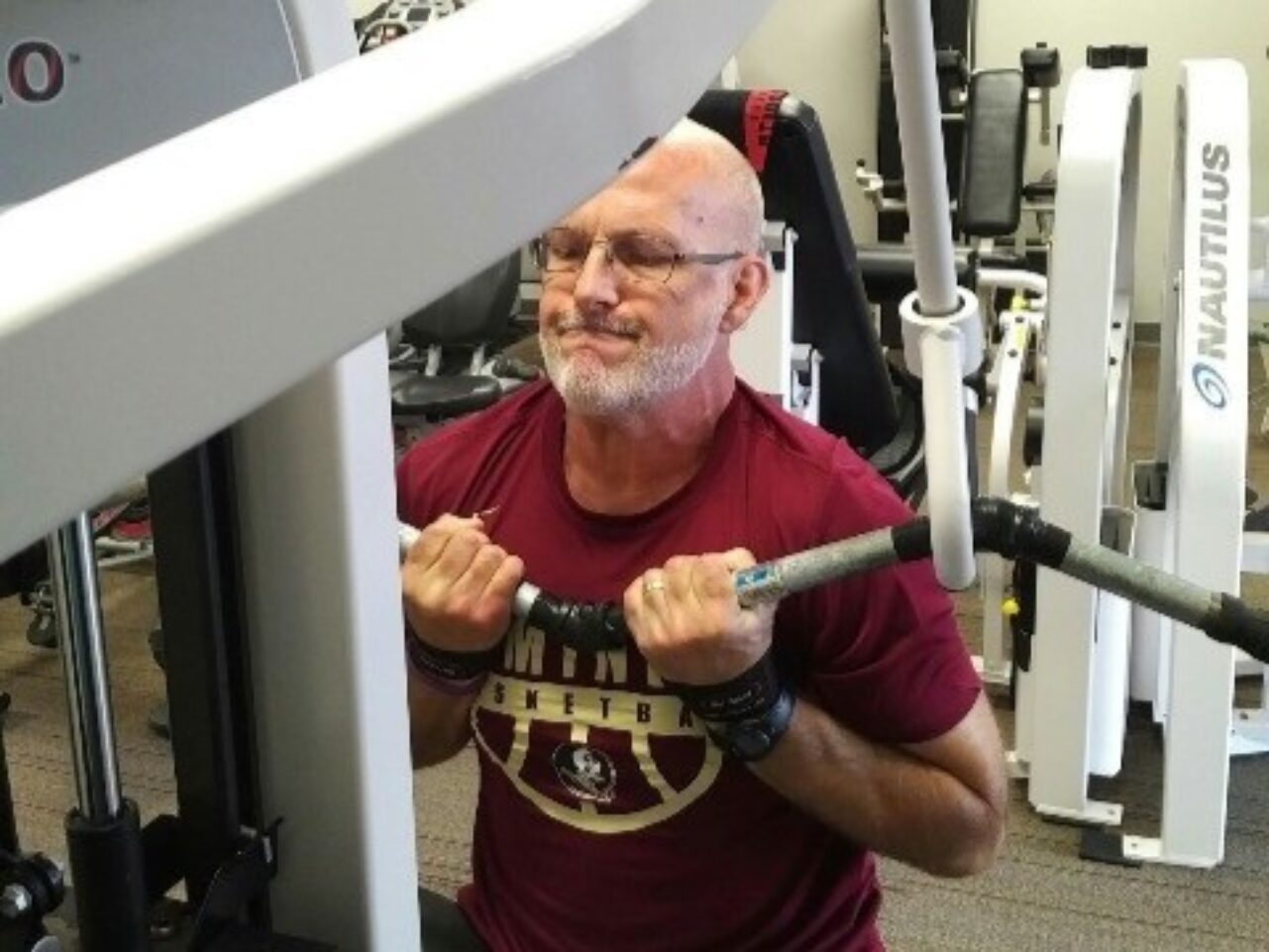
When time is limited, compound exercises should form the foundation of your workouts.
Some of the best choices include:
- Squats or leg presses
- Chest presses
- Seated or bent-over rows
- Lat pulldowns
- Overhead presses
Isolation exercises like biceps curls and triceps extensions can certainly have a place, but they should come after you’ve completed the movements that provide the greatest overall benefit.
Principle #3: Train Hard—But Safely
One of the biggest reasons people fail to build more muscle after 50 isn’t because they train too little—it’s because they never challenge their muscles enough.
Muscle growth requires effort.
That means lifting the heaviest weight possible while still maintaining perfect form, and putting in a maximum effort by taking every set to a point of muscular failure.
If you could easily perform another five or six repetitions, the weight is probably too light to maximize muscle growth.
On the other hand, you should never use a weight that’s so heavy you can only complete 1 or 2 or 3 repetitions.
The sweet spot is challenging your muscles while maintaining excellent form from the first repetition to the last, and performing somewhere between 7-12 repetitions.
Principle #4: Progress Every Week
Muscles grow because they’re forced to adapt to increasing demands.
If you perform the exact same workout with the same weights for months, your body has no reason to build additional muscle.
Progressive overload simply means asking your muscles to do a little more over time.
Progress doesn’t always require heavier weights. You can also:
- Perform one additional repetition.
- Improve your lifting technique.
- Increase your range of motion.
- Slow the lowering phase of each repetition.
These small improvements may seem insignificant from one workout to the next, but they add up dramatically over months and years.
Remember, your goal is to become just a little stronger and a little more capable than you were last week.
How Hard Should You Train?
One of the most common questions people ask is whether they need to lift heavy weights to build muscle.
The answer is a little more nuanced than that.
Research shows that muscles respond to effort, not simply the amount of weight on the bar.
Whether you’re lifting a relatively heavy weight for six repetitions or a lighter weight for twelve to fifteen repetitions, muscle growth can occur—as long as the final repetitions are challenging.
The key is reaching a level of effort that forces your muscles to adapt.
Why You Don’t Need Marathon Workouts
Many people mistakenly believe that muscle growth comes from doing more exercises or spending more time lifting.
In reality, once you’ve completed several challenging sets for each major movement pattern, additional volume often contributes more fatigue than results.
Think of your workouts as creating a stimulus—not trying to completely exhaust yourself.
Your objective is to give your muscles a reason to grow, then leave the gym so your body can begin repairing and rebuilding.
If your workouts take longer than 1 hour and feeling like you’ve been hit by a truck, you’re probably doing too much.
On the other hand, if every workout feels easy, you’re probably not doing enough.
Aim for challenging, focused sessions that leave you feeling accomplished—not destroyed.
Recovery Is Where Muscle Is Actually Built
Here’s one of the biggest misconceptions in fitness:
People often think muscles grow while they’re lifting weights.
They don’t.
Strength training creates tiny amounts of stress and microscopic damage within muscle fibers. During recovery, your body repairs that damage and builds the muscles back stronger and slightly larger in preparation for the next challenge.
Without adequate recovery, that rebuilding process is incomplete.
That’s why recovery isn’t a break from making progress—it is the process of making progress.
Prioritize Sleep
If there were a legal performance-enhancing drug for building muscle after 50, it would probably be quality sleep.
During deep sleep, your body releases hormones involved in tissue repair, muscle recovery, and overall healing. Sleep also helps restore your nervous system so you’re ready to perform at your next workout.
Most adults should aim for seven to nine hours of quality sleep each night.
Poor sleep doesn’t just reduce energy levels. It can also:
- Slow muscle recovery
- Reduce workout performance
- Increase cravings for unhealthy foods
- Make consistent training more difficult
Protecting your sleep is one of the easiest ways to improve your results without spending another minute in the gym.
Rest Days Are Growth Days
Many people feel guilty taking days off.
They shouldn’t.
Your muscles don’t know whether it’s Monday or Thursday—they only know whether they’ve had enough time to recover from the last training session.
Those two or three days between workouts allow:
- Muscle fibers to repair and grow
- Connective tissues to recover
- Inflammation to subside
- Energy stores to replenish
- Your nervous system to reset
Trying to rush this process often leads to stalled progress rather than faster gains.
Stay Active Between Workouts
Recovery doesn’t mean spending the entire day on the couch.
Light activity actually helps many people recover faster by improving circulation and reducing stiffness.
Excellent recovery activities include:
- Walking
- Gentle cycling
- Mobility exercises
- Stretching
- Easy swimming
- Light recreational activities
These activities keep your body moving without interfering with your strength-training progress.
Think of them as supporting your workouts rather than replacing them.
When you combine two focused strength-training sessions with excellent recovery habits, you’re creating the ideal environment to build more muscle after 50.
Your workouts provide the stimulus, but your recovery determines how much of that hard work is transformed into stronger, healthier muscle.
Common Mistakes That Keep People Over 50 From Building Muscle
If you’re putting in the effort but not seeing the results you expected, don’t assume it’s because you’re “too old” to build muscle.
More often than not, progress stalls because of a few common training and nutrition mistakes—not because of age itself.
The good news is that once you recognize these roadblocks, they’re usually easy to fix.
Not Training Hard Enough
This is by far the most common mistake.
Many adults over 50 become overly cautious with weights because they’re worried about getting injured.
While training safely is essential, using weights that are too light won’t provide enough stimulus for your muscles to grow.
A simple test is to ask yourself how many more repetitions you could have completed at the end of each set.
- If the answer is five or six, the weight was way too light to stimulate an increase in strength or muscle size.
- If you could not perform even one or two more reps with good form, you’re likely in the ideal range for muscle growth.
Remember, muscles don’t respond to easy—they respond to challenge.
Changing Workouts Every Week
It’s tempting to try the latest workout you see on YouTube or social media.
The problem is that constantly changing exercises makes it nearly impossible to measure progress.
Instead, stick with the same core exercises for several weeks or even a few months. This allows you to gradually increase the weight, improve your technique, and clearly see your strength improving.
Consistency builds muscle. Constant variety often builds frustration.
Using Weights That Are Too Light
There’s an important difference between lifting safely and lifting timidly.
Many people never increase the resistance because the current weight feels “comfortable.” Unfortunately, comfort rarely leads to muscle growth.
As exercises begin to feel easier, challenge yourself by adding a small amount of weight, performing another repetition, or slowing down your rep speed.
Small, consistent increases create remarkable results over time.
Skipping Progressive Overload
Your muscles adapt quickly.
If today’s workout looks exactly like the one you did three months ago, your body has no reason to continue building additional muscle.
Progressive overload doesn’t require dramatic jumps in weight. In fact, the smallest improvements are often the most sustainable.
Look for opportunities to:
- Add one repetition.
- Increase the weight slightly.
- Improve your lifting technique.
- Slow the lowering phase of each repetition.
- Perform the movement with better control.
Those incremental improvements are what allow you to build more muscle after 50 year after year.
Not Eating Enough Protein
You can’t build new muscle without the raw materials to do so.
Unfortunately, many adults over 50 consume significantly less protein than their muscles need for optimal growth and repair.
Aim to include a quality source of protein at each meal and spread your intake throughout the day rather than consuming most of it at dinner.
Strength training provides the stimulus. Protein supplies the building blocks.
Doing Too Much Cardio
Cardiovascular exercise is excellent for heart health, endurance, and overall well-being.
However, if your primary goal is muscle growth, hours of daily cardio can interfere with recovery and reduce the energy available for effective strength training.
Think of cardio as a complement to your muscle-building program—not the main event.
A few moderate sessions each week are usually enough to support overall health while allowing your muscles to recover and grow.
Expecting Results Too Quickly
Perhaps the biggest mistake of all is giving up too soon.
Building muscle after 50 is a long-term investment.
You’ll probably notice strength improvements before you see visible muscle growth. That’s perfectly normal.
Instead of focusing only on the mirror, celebrate signs of progress such as:
- Lifting heavier weights
- Performing more repetitions
- Better balance
- Improved posture
- Greater energy
- Easier everyday activities
Those victories are evidence that your body is changing—even if the mirror hasn’t fully caught up yet.
Conclusion
If there’s one message to take away from this article, it’s this:
You don’t have to spend countless hours in the gym to build more muscle after 50.
In fact, for most adults, two focused strength-training sessions each week provide the perfect balance between challenging the muscles and allowing the body enough time to recover.
The formula is surprisingly simple:
- Train your entire body, focusing on compound exercises.
- Work hard enough to challenge your muscles.
- Progress gradually over time.
- Eat enough protein.
- Prioritize recovery just as much as your workouts.
None of these habits are flashy, but together they create a powerful system for building muscle, increasing strength, and improving your health for decades to come.
The best workout program isn’t the one that looks the most impressive on paper—it’s the one you can perform consistently month after month and year after year.
Two short workouts each week may not sound revolutionary, but when those workouts are intentional, progressive, and supported by proper recovery, they can help you build more muscle after 50 than you ever thought possible.
So don’t wait until you have “more time.”
Start with two workouts this week, focus on getting just a little stronger each time, and let consistency do what complicated fitness programs often fail to accomplish.
Small efforts, repeated week after week, produce extraordinary results.
Frequently Asked Questions
Can you really build more muscle after 50 with only two workouts a week?
Yes. For most adults over 50, two challenging full-body strength workouts each week are enough to stimulate muscle growth when combined with progressive overload, adequate protein, and sufficient recovery.
The quality of your workouts matters far more than the number of days you spend in the gym.
How long should each workout be?
Most people can build more muscle after 50 with workouts lasting 25 to 35 minutes. Focus on compound exercises, limit unnecessary volume, and train with purpose rather than simply extending your workout.
What are the best exercises to build muscle after 50?
Compound exercises provide the greatest return on your time because they work multiple muscle groups at once. Excellent choices include squats, leg presses, chest presses, rows, lat pulldowns, and overhead presses.
Do I have to lift heavy weights to build muscle?
Not necessarily. You do need to challenge your muscles, but that can be accomplished with moderate weights performed close to muscular fatigue. The goal is to finish your sets with a maximum effort, while maintaining good form.
How much protein do I need to build more muscle after 50?
Most active adults over 50 benefit from consuming approximately 1.2 to 1.6 grams of protein per kilogram of body weight each day, spread across multiple meals to maximize muscle protein synthesis.
Is walking enough to build muscle after 50?
Walking is an excellent form of exercise for cardiovascular health, mobility, and maintaining an active lifestyle.
However, it doesn’t provide enough resistance to significantly increase muscle mass. Resistance training remains essential if your goal is to build more muscle after 50.
Should I do cardio if my goal is muscle growth?
Yes. Moderate amounts of cardio support heart health, endurance, and recovery. Just avoid allowing excessive cardio to interfere with your strength-training sessions or recovery.
What if I miss one of my weekly workouts?
Don’t try to “make up” the missed workout by doubling your next session. Simply return to your normal schedule as soon as possible. Long-term consistency is much more important than any single missed workout.
Is it too late to build muscle in your 60s or 70s?
Absolutely not! Research has repeatedly shown that adults in their 60s, 70s, and even 80s can gain muscle, improve strength, increase bone density, and enhance their quality of life through regular resistance training.
It’s never too late to become stronger.

2 Comments. Leave new
Great information as usual, Dave.
After 50 years of training, I still struggle with the recovery part because I like to be active daily. I really like cycling and ride 50-60 miles a week. That’s usually scattered over several days and my rides are generally intense in nature due to terrain and strong winds in my area. I will blend in my strength training as I see fit, but usually reduce my total exercises to 3-4 for 1 set per session. I have about 12 exercises I rotate through over the course of about 10 days or so. I’ve also switched to using resistance bands exclusively and usually use a higher rep scheme and always focusing on controlled movement. The systemic fatigue is what gets me usually. It becomes quite dicey covering all the different aspects of health and fitness as we age: the right amount of aerobic exercise, mobility/flexibility, covering all the areas we need to strengthen to stay strong, functional and injury free AND the proper amount of rest. Keep up the great work and I look forward to your next post. 👍
Hey Fred, great to hear from you! Recovery is definitely a big challenge at this stage of life, Between trying to enhance (or at least maintain) each component of fitness, and live a full, active life, it can start to feel like a jigsaw puzzle. It sounds like you’ve got it pretty well figured out! Glad you enjoyed the article.